


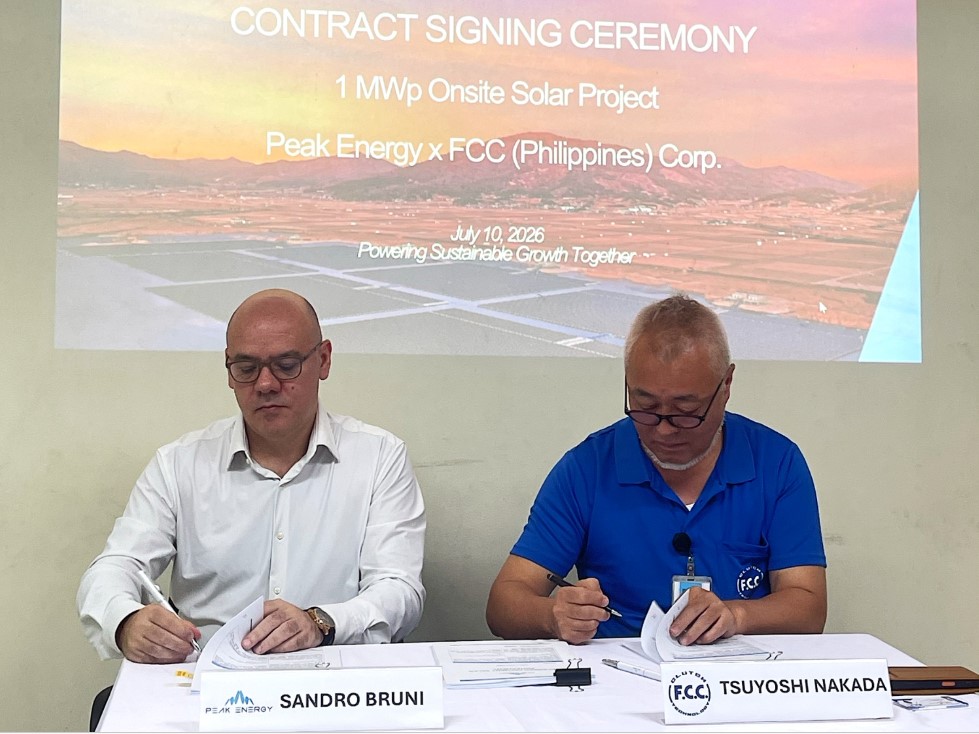
FCC (Philippines) Corp., the local unit of Japanese automotive components manufacturer FCC Co., Ltd., has signed a 15-year agreement with renewable energy developer Peak Energy to install a 1-megawatt-peak (MWp) rooftop solar system at its manufacturing facility in Laguna, as more industrial companies turn to onsite renewable energy to reduce electricity costs and carbon emissions.
Under the agreement, Peak Energy will design, finance, construct, own, operate and maintain the solar installation, allowing FCC Philippines to purchase renewable electricity without making any upfront capital investment.
The rooftop solar system is expected to generate around 1,500 megawatt-hours (MWh) of electricity during its first year of operation, supplying power at a price approximately 30% lower than prevailing grid tariffs, the companies said. The installation is also projected to reduce carbon dioxide emissions by about 650 metric tons annually, equivalent to avoiding the consumption of nearly 252,000 liters of gasoline.
Commercial and industrial rooftop solar has become one of the fastest-growing segments of the Philippine renewable energy market as manufacturers seek to lower electricity costs, reduce exposure to volatile power prices, and meet sustainability commitments increasingly required by global customers and supply chains.
FCC, which has operated in the Philippines since 1993, manufactures integrated clutch systems for major global automotive and motorcycle brands. The company said the solar project supports the FCC Group’s target of reducing carbon emissions by 50% by 2030 and achieving carbon neutrality by 2050.
“This solar project represents an important milestone in FCC’s journey toward a more sustainable future,” said Tsuyoshi Nakada, president of FCC (Philippines) Corp. “As part of the FCC CO., LTD. Group’s commitment to achieve carbon neutrality by 2050, with a 50% reduction in carbon emissions by 2030, we continue to invest in initiatives that reduce our environmental footprint while strengthening the resilience of our operations.”
Peak Energy said the project reflects growing demand among industrial companies for lower-cost renewable electricity.
“Industrial buyers in the Philippines are increasingly looking for power that’s cheaper than the grid and shielded from imported fuel prices,” said Gavin Adda, chief executive officer of Peak Energy. “This project delivers both, at a 30% discount to grid tariffs.”
The project adds to Peak Energy’s portfolio of commercial and industrial renewable energy installations serving multinational manufacturers across Asia, including JTEKT in Japan, AICA in Thailand and Yokogawa in Singapore.
The Department of Energy aims to increase the share of renewable energy in the country’s power generation mix to 35% by 2030 and 50% by 2040, with greater participation from the private sector expected to help meet those targets.
The FCC project reflects a broader trend among manufacturers operating in the Philippines to adopt onsite renewable energy through long-term power purchase agreements, enabling companies to lower operating costs while advancing corporate decarbonization goals and strengthening the sustainability of their global supply chains.

